







The future belongs to those who blend science with heart.
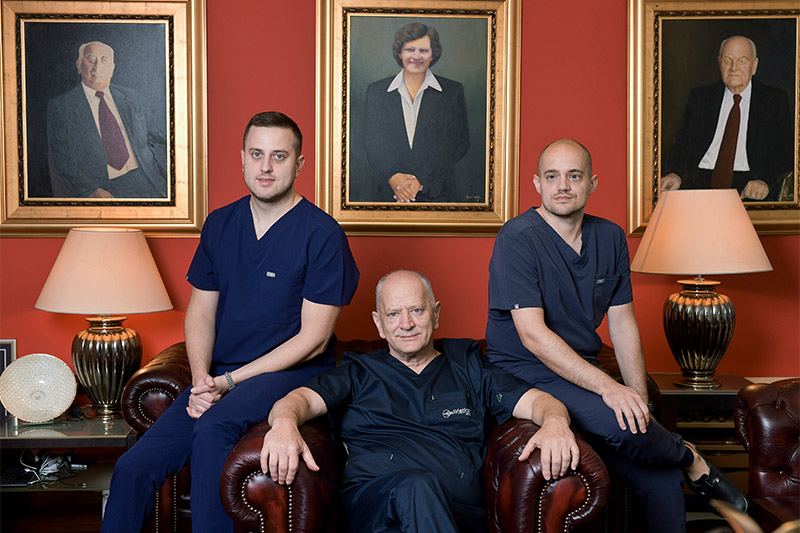
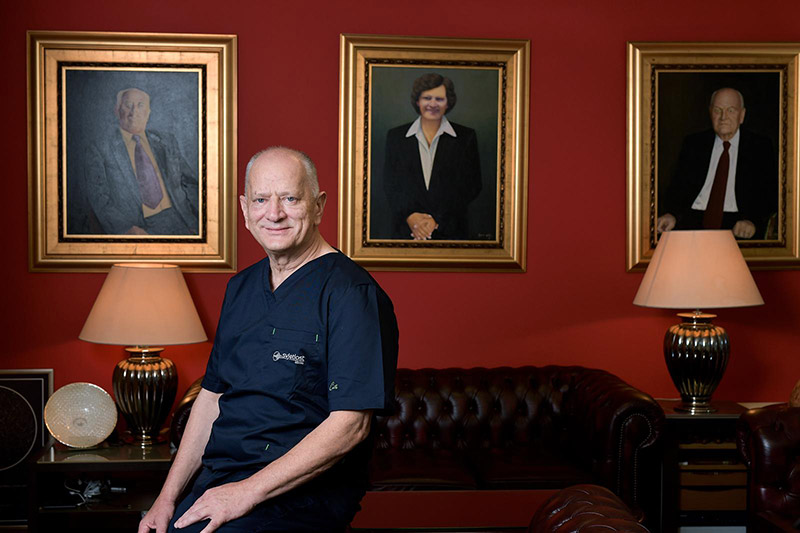
Prof. Nikica Gabrić: Ophthalmology is expected to become a crucial field in maintaining workforce productivity over the next 25 years. As a result, refractive surgery will become a strategic branch of medicineProf. Nikica Gabrić, MD, PhD, director of the Svjetlost Special Hospital for Ophthalmology, which grew from a polyclinic to a clinic in 2010 and thus became the first private university clinic in Croatia, introduced a whole range of new surgical procedures into Croatian medicine (ultrasound-guided cataract surgery, amniotic membrane transplantation, sulcus-fixated intraocular lenses, and cataract surgery with intraocular lens implantation in children). He was also the first surgeon in Croatia to perform laser vision correction. He significantly contributed to the development of transplant medicine and played a key role in establishing the country’s first tissue bank, the Lions Croatian Eye Bank. Through his commitment and expert support, additional eye banks were subsequently opened in Rijeka, Osijek, and Split.
He is the founder and president of the Croatian Society for Cataract and Refractive Surgery. He was a board member of the European Society of Cataract and Refractive Surgery (ESCRS), the European Eye Bank Association (EEBA), and is a board member of the European Society of Ophthalmology (SOE) and the South East European Ophthalmological Society (SEEOS). He is an active member of the Croatian Medical Association, the Croatian Ophthalmological Society, the American Academy of Ophthalmology, the Croatian Academy of Medical Sciences, the Association for Research in Ophthalmology (ARVO), the Association for Diseases of the Anterior Segment of the Eye, and the American Society of Cataract and Refractive Surgery. All of this is more than a sufficient reason to discuss the future of ophthalmology with Professor Gabrić.
Gene therapy targeting hereditary eye disorders is developing remarkably fast. How soon could gene therapy become standard practice here — and which disorders do you believe will be the first to benefit?
Gene therapy is no longer a future prospect, but the dawn of a new era. Gene therapy in ophthalmology is advancing at an extraordinary pace. There are already the first approved therapies for hereditary diseases such as Leber’s congenital amaurosis and retinitis pigmentosa, but these are rare conditions that affect only a small number of people.
Treatment for certain genetic eye diseases is already available in Croatia, so this is not merely a future concept. Much more important will be the application of gene and cell therapies for diseases that affect millions - corneal endothelial disorders, macular degeneration, and glaucoma. As these diagnoses are the primary causes of permanent vision loss today, I foresee the most substantial breakthroughs happening here.
In the near future, gene therapy will expand beyond treating inherited disorders to include approaches aimed at slowing or preventing ocular aging. This marks the point at which medicine shifts from being reactive to preventive - when we intervene before disease develops. Svjetlost will also participate in a large study on the use of a gene-based drug for the company AbbVie.
Progress in bionic vision technologies, such as retinal implants and artificial photoreceptors, continues to accelerate annually. How realistic is it to expect that blind patients might regain functional sight by 2050?
Bionic vision development is among the most fascinating frontiers of modern medicine. Retinal implants and artificial photoreceptors are already available today, enabling individuals who are completely blind to perceive visual outlines. However, although these technologies are technically feasible, the major challenge is economic - the devices are extremely costly, and companies often withdraw because they see no sufficient market demand. Without commercial motivation, progress comes to a halt. By 2050, many blind individuals will have functional vision, but this will not be the achievement of a single company, but the outcome of global cooperation between science, public health, and industry. At Svjetlost, we are already implanting miniature telescopic lenses that restore vision and function in patients with end-stage macular degeneration - this is not the future, but the present.
Nanotechnology enables the targeted delivery of medications to the eye. In your view, what is the future role of nanocapsules, nanoparticles, and “smart” eye drops in managing glaucoma, macular degeneration and infections?
We are already using microdoses of medications that are precisely delivered into the eye by means of nanoparticles and capsules. The “smart” eye drops of the future will adjust the amount of drug released based on tissue pressure or oxygen concentration. This will particularly transform the treatment of glaucoma and macular degeneration. Instead of administering eye drops three times a day, a single dose per week or even per month will be enough. Adverse effects will decrease, while compliance and disease management will improve; moreover, sensors will enable physicians to track therapeutic outcomes in real time.
Initial successful outcomes of corneal 3D bioprinting have already been achieved in laboratory research. How far are we from bioprinting patient-specific corneas or ocular tissues, and might this serve as an alternative to classical transplantation?
3D-bioprinting of the cornea is no longer science fiction. Cell layers that replicate corneal tissue are already being successfully produced in laboratories, and I anticipate the first clinical use within the next decade. During the first phase, its role will be to replace donor corneal transplants, especially when scarring or endothelial impairment is present. In the long run, this could mark the end of conventional transplantation. The cornea is an ideal target for 3D bioprinting because it is made of acellular collagen fibers, which means that artificial materials can be used directly once they reach sufficient quality and transparency.
To what extent will artificial intelligence reshape diagnostic practices in ophthalmology? Is it realistic to anticipate that artificial intelligence (AI) will completely assume the early diagnostic role in diabetic retinopathy, glaucoma, and macular degeneration?
AI isn’t replacing doctors; it’s transforming what their job looks like. Right now, algorithms can identify diabetic retinopathy, glaucoma, and macular degeneration just as accurately as eye-care experts. AI will analyze millions of images and detect diseases in their earliest stages, while the ophthalmologist will become a strategist who plans therapy and guides the patient. Companies are unwilling to take full legal responsibility, so doctors will remain at the center of the system for a long time to come. And that is a good thing - because physicians will be able to focus more on actual treatment and less on administration.
We are already hearing about future devices in the form of “contact lenses with built-in sensors”. Is it realistic to expect smart lenses that monitor blood pressure, glucose levels, or display data to become a new reality?
Smart contact lenses may appear promising in science fiction scenarios, but a realistic perspective is necessary. Current technology has only recently advanced to the point where bulky glasses - like the RayBan Meta AI model - can hold batteries, microphones, and processors. There is simply no way to fit a constantly powered battery and electronics into a transparent lens just 14 millimeters in diameter and under 0.2 mm thick. That is why I believe that “smart” lenses will evolve into therapeutic systems for slow and controlled release of medication. Instead of integrating screens and processors, they will contain medications - a realistic and valuable direction of development that could transform the treatment of glaucoma, infections, and dry eye.
Laser surgery has made tremendous advances over the past 20 years. Do you see a future in AI-driven laser platforms that operate fully autonomously, with only minimal human supervision?
Lasers have reached maturity, but they are far from finished.
I purchased my first PRK laser back in 1998. At the time, the bank refused to give me a loan because they didn’t understand what such a device was even intended for. Today, 27 years later, Svjetlost is actively participating in the development of two of the four laser platforms available worldwide (the Schwind ATOS and Johnson & Johnson Elita). These are advanced systems that enable patients to resume their normal activities the very next day after surgery. But a laser that performs the entire procedure on its own? I don't believe we'll see that by 2050, because the surgeon will still need to keep control of the procedure. No company is willing to assume full legal liability for a surgical procedure. Since, 2008 the Schwind Amaris has included a TPRK module that centers itself on the eye and performs the procedure, while the surgeon only presses the pedal. The real challenge is not automation, but the global epidemic of myopia and age-related visual decline. In China, high myopia affects more than half of the population, which has become an issue of national productivity. Presbyopia, the need for reading correction, will represent an even bigger challenge. It affects over two billion individuals worldwide. The ultimate objective is not to develop a laser that functions independently, but to return the natural lens to its original state, enabling it to accommodate and focus once again.
To what extent will virtual and augmented reality technologies (VR/AR) reshape ophthalmic education and surgical practice?
Robotic cataract procedures are likely to be the standard of care before 2050, although the shift will not happen overnight.
By 2050, numerous blind patients will regain functional vision, however; this will not be the result of one company’s innovation, but of worldwide collaboration among science, healthcare systems, and industry.
At Svjetlost, we’re already giving back vision and daily function to end-stage macular degeneration patients using tiny telescopic implants - this isn’t the future; it’s happening now.
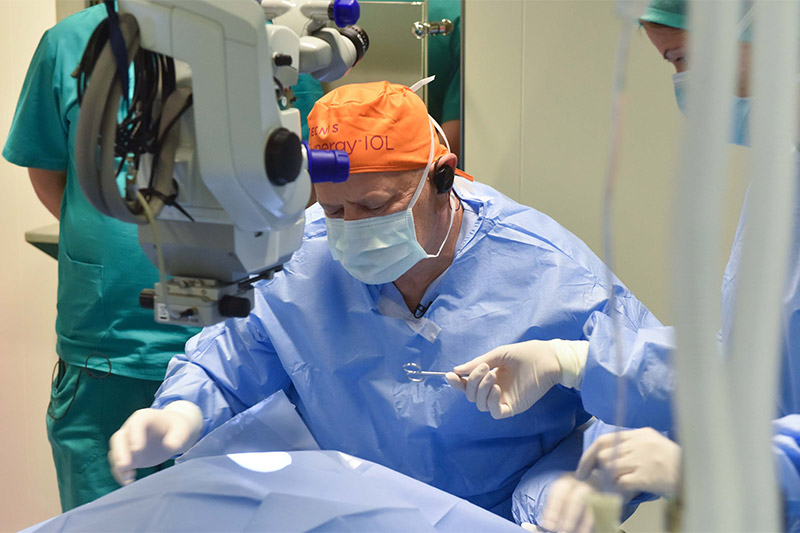
My colleague and friend Dr. Uday Devgan, who attended our congress in Zagreb last year and visited the Svjetlost Clinic, recently demonstrated the first robotic cataract surgery in history, where the surgeon remotely controlled a system that precisely replicated his movements inside the eye. That moment marks the beginning of an era where the human hand integrates with digital precision. Nevertheless, robotics will not take the place of the doctor. He will become the architect of the procedure - while the robot executes precise micromovements, only the doctor comprehends the tissue and unexpected circumstances outside predefined protocols. This represents not a threat, but the natural evolution of the profession. Similar to how pilots now fly with autopilot systems, surgeons will one day perform procedures with robotic assistance.
Is robotic cataract surgery expected to become the standard of care? Do you anticipate a future in which robots carry out the majority of procedures and the ophthalmologist assumes a supervisory and planning role, or is this a development we should fear?
We are already capable of promoting self-renewal in corneal cells, and similar technology will soon be applicable to photoreceptors. Once we learn to activate self-renewal mechanisms, we will see therapies that do not replace lost cells, but restore their viability. Over the next 25 years, ophthalmology will become essential for maintaining human working ability. If we do not treat these patients surgically, they will lose their ability to work and their economic productivity. That is why refractive surgery will become a strategically important field of medicine.
Regenerative medicine seeks to stimulate the eye’s own ability to regenerate — from corneal stem cells to the renewal of photoreceptors. Do you consider it possible that by 2050 treatments will exist that restore lost cells instead of simply replacing them?
We are approaching an era in which medical progress is occurring at an unprecedented pace. Young doctors should not fear technology - they should embrace it, understand it, and use it as a tool. Artificial intelligence, robotics, biotechnology, and genetics are nothing more than tools. What will always remain decisive is human empathy, understanding, and the commitment to help others. The future belongs to people who bring together science and heart. And fundamentally, that is what characterizes a good physician.